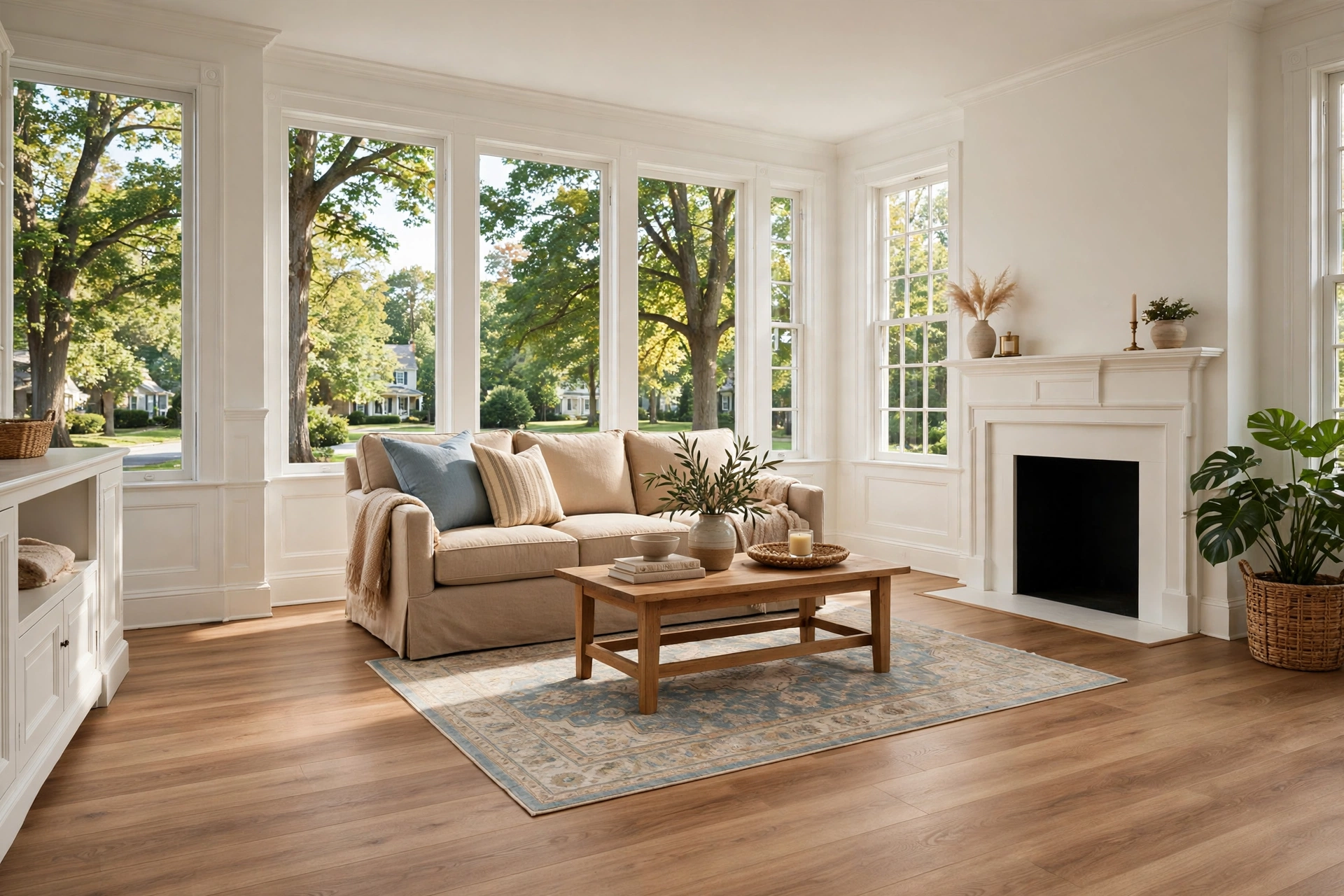
Luxury Vinyl Plank Installation in Bowie, Maryland, with published price ranges up front, the rooms measured and the subfloor checked on site, and one written figure before any work begins.
Luxury Vinyl Plank Installation in Bowie, MD by Bowie LVT Flooring Company
We install luxury vinyl plank in Bowie homes where the existing floor has quietly given up. Sometimes that means carpet in a living room that still looks acceptable from the doorway but feels thin and tired underfoot. Sometimes it means laminate that clicks when you cross it, or sheet vinyl that has curled at a seam and now catches every mop that passes.
Bowie houses ask a lot of a main floor. Dogs come in from fenced yards with wet paws in March and dust on their feet in August. Hallways carry groceries, laundry baskets, school bags, and furniture that gets shifted twice a year for holidays. Entry floors take rain and road grit all winter long.
Plank answers that daily wear without asking the household to treat the floor like furniture. Boards run long and wide like wood, the surface shrugs off spills that need quick attention rather than panic, and a room can go back into normal use the same evening the last board locks in.
What Luxury Vinyl Plank Is Made Of
A plank looks simple from above. Under the printed wood image sits a layered build that decides how the floor will live. The top layer is the wear layer, a clear surface measured in mil, and thicker options in that layer stand up better to dog nails, chair legs, and grit ground in at the front door.
Beneath that surface sits the core. Rigid core products built on SPC construction feel firm and steady, and they resist dents from heavy furniture better than softer builds. WPC construction feels a touch softer and quieter underfoot, a quality many bedroom floors benefit from.
Both core types are built as waterproof cores. That fact matters at the sink, at the dog water bowl, and at the refrigerator line, three places where Bowie kitchens and utility spaces see water far more often than owners expect.
How Plank Installation Runs in a Bowie Home
Work begins before a single board comes out of a box. Crews measure each room, check door swings, and look hard at the subfloor through floor vents, at thresholds, and along walls where older floors often hide their worst news. Low spots get marked. Squeaks get noted. Soft areas near tubs or exterior doors get probed rather than covered over.
Old material comes up next. Carpet and pad lift quickly in most rooms, while glued sheet goods take slower and louder work. Staples, tack strips, and old adhesive ridges have to go, because a new plank floor will show a ridge left underneath it as a faint line that catches light and annoys everyone for years.
Installation itself moves in straight, satisfying rows once prep is done. Boards lock edge to edge, cuts fit tight at walls and around door casings, and expansion space stays hidden under trim at the perimeter. Baseboards reset at the end, transitions land flat at every doorway, and each room gets a final check for door clearance before furniture returns.
Recent Project: Luxury Vinyl Plank Installation in Melford
BEFOREAFTER
A Melford living room, hall, and dining room carried carpet that had flattened across every traffic path and showed staining near the rear slider. Crews removed the carpet and pad, found a low run along one joist line, and leveled that section before any plank went down. Rigid core plank then ran through all three spaces as one continuous floor, with tight cuts at the fireplace surround and flat transitions into the kitchen. Trim reset and a full clean finished the job, and the rooms read as one open surface for the first time.
Turnaround
Three days on site from carpet removal to final trim.
Final Price
$5,995
Luxury Vinyl Plank Installation Cost in Bowie, MD
No Bowie company publishes a local price list, and the figures here are published figures offered for planning only. Published guides put luxury vinyl plank installed at $3 to $8 per square foot. Those same published guides put a 1,000 square foot job at $3,000 to $8,000, and install only labor commonly at $1.50 to $4.50 per square foot in published guides. For this service, published figures place typical Bowie scope work at $3,400 to $7,800.
Where a given house lands inside that span depends on a short list of plain factors. Square footage comes first. Product grade comes second, because wear layer thickness, core build, and plank size all change material cost per box. Removal of glued sheet vinyl takes longer than rolling up carpet, and leveling a wavy subfloor adds both material and hours.
Small cut heavy rooms also run higher per foot than long open runs. Your written figure follows the site visit, once rooms have been measured and the subfloor has been seen rather than guessed at from a doorway.
How We Help You Pick the Right Plank
Product talk starts with how the room gets used, not with a color chart. A living room with two large dogs needs a thicker wear layer than a quiet guest room that sees slippers twice a month. A kitchen floor needs a core and surface that tolerate water, dropped cans, and stools that slide in and out a dozen times a day.
Samples then go down in the actual room. Light in Bowie houses changes across the day, and a board that reads warm at noon can read gray at dusk under kitchen lighting. Grain pattern matters at scale too. A bold grain that charms in a single sample board can shout when it repeats across a whole main level.
In Maryland, LVT installation falls under MHIC governed home improvement work as a market matter, and work in Bowie sits within Prince George's County processes in general terms. Our part stays practical. Measure honestly, prep the ground the floor will sit on, fit the product the room actually needs, and walk every seam and transition with you before the job closes.
How much does luxury vinyl plank installation cost in Bowie, MD?
Published guides put luxury vinyl plank installed at $3 to $8 per square foot, a 1,000 square foot job at $3,000 to $8,000, and install only labor commonly at $1.50 to $4.50 per square foot. Published figures for this service in Bowie run $3,400 to $7,800, with square footage, product grade, removal, and leveling setting your place inside that span.
Can plank go over my existing floor?
Occasionally, yes, and often, no. A sound, flat, firmly fixed floor can sometimes stay under new plank, but carpet, pad, loose sheet vinyl, and damaged boards always come up. Covering a soft or wavy surface only hides the problem under a floor that will flex, click, and wear early.
Which wear layer should a house with dogs choose?
Busy Bowie houses with dogs usually do best with a thicker wear layer option, since nails, grit, and daily traffic test the surface more than occasional spills do. During the visit we match thickness to your traffic, your pets, and the rooms involved instead of pushing one grade for every house.
How long will my living room be out of use?
Most single rooms return to use the evening installation finishes, once trim is reset and furniture can go back with pads under the legs. A connected main level takes longer because rows run through several spaces in sequence. The schedule for your rooms is stated before work begins, so the household can plan around the days each space is active.
Does plank feel cold like tile in winter?
Plank feels closer to wood than to ceramic tile under bare feet. Rigid core products feel firm, while softer core builds give a slightly warmer and quieter step.
What should I clear before installation day?
Small furniture, breakables, closet contents at floor level, and pet supplies should move out of the work rooms ahead of the crew. Large pieces can often shift within a room in stages, and that plan gets settled during the visit. Clear rooms let prep and installation run without pauses, which keeps the schedule you were given intact.
Get Your LVT Flooring Quote
Tell us which rooms need floors. We read every request that comes in and respond with the published range for that kind of work and the next step, starting with a visit to measure the rooms and check the subfloor.
Prefer to talk it through first? Send the form and we will call you back at the number you give us.